
How Much Does Psychological Testing for a Child Cost, and Will Insurance Cover It?

If you have been circling the idea of getting your child evaluated, there is a good chance one question has been sitting underneath all the others, unasked.
What is this going to cost us?
It is a hard question to ask out loud. It can feel like putting a price tag on your child, or like admitting that money might decide something it shouldn't. So parents often skip past it. They read about ADHD and dyslexia and executive function, they gather information for months, and they never quite get a straight answer about the money until they are already on a phone call with a practice, feeling caught off guard.
We would rather you have the numbers now, at your kitchen table, before you talk to anybody.
In this post we’ll cover:
What a comprehensive psychological evaluation for a child actually costs.
Why it costs that.
What insurance typically covers.
How insurance reimbursement works when a practice is out-of-network.
Exactly what to say when you call your insurance company.
We have also included our own fees, plainly, because we believe in transparency and think you deserve to know before you pick up the phone.
How much does psychological testing for a child cost?
A comprehensive private psychological or neurodevelopmental evaluation for a child typically runs somewhere between about $3,000 and $6,000 in the United States, depending on the scope of the evaluation, the region, and the depth of the report. At Webb Psychological Services, evaluations are a flat fee of $4,500.
That number covers a lot of ground, so here is what is inside it:
The parent intake interview
Up to nine hours of in-person, one-on-one testing with your child
Scoring of every measure administered
Interpretation of the data
Review of prior records — school evaluations, report cards, pediatrician notes, previous testing
Consultation with your child's other providers, teachers, or learning support staff
A written report
A feedback session where we sit down and walk you through all of it
There are no separate charges layered on top of that. No per-test fees, no report-writing fee, no charge for the phone call with your child's teacher, - just one number, agreed on before we begin.
Why does a neurodevelopmental evaluation cost so much?
Because you are not paying for an appointment. You are paying for roughly 20 to 25 hours of a licensed psychologist's time. A comprehensive evaluation requires about 10 to 15 face-to-face hours with your family and another 12 to 20 hours of interpretation, integration, writing, and consultation that happens after your child goes home.
This is the single biggest misunderstanding about testing costs, and it is worth slowing down on.
When you bring your child in for testing, you see the visible part: an intake conversation, two or three testing days, a feedback meeting. What you do not see is the work that happens between the last testing session and the feedback session — and that part is usually larger than the part you witnessed.
Here is roughly where the hours go:
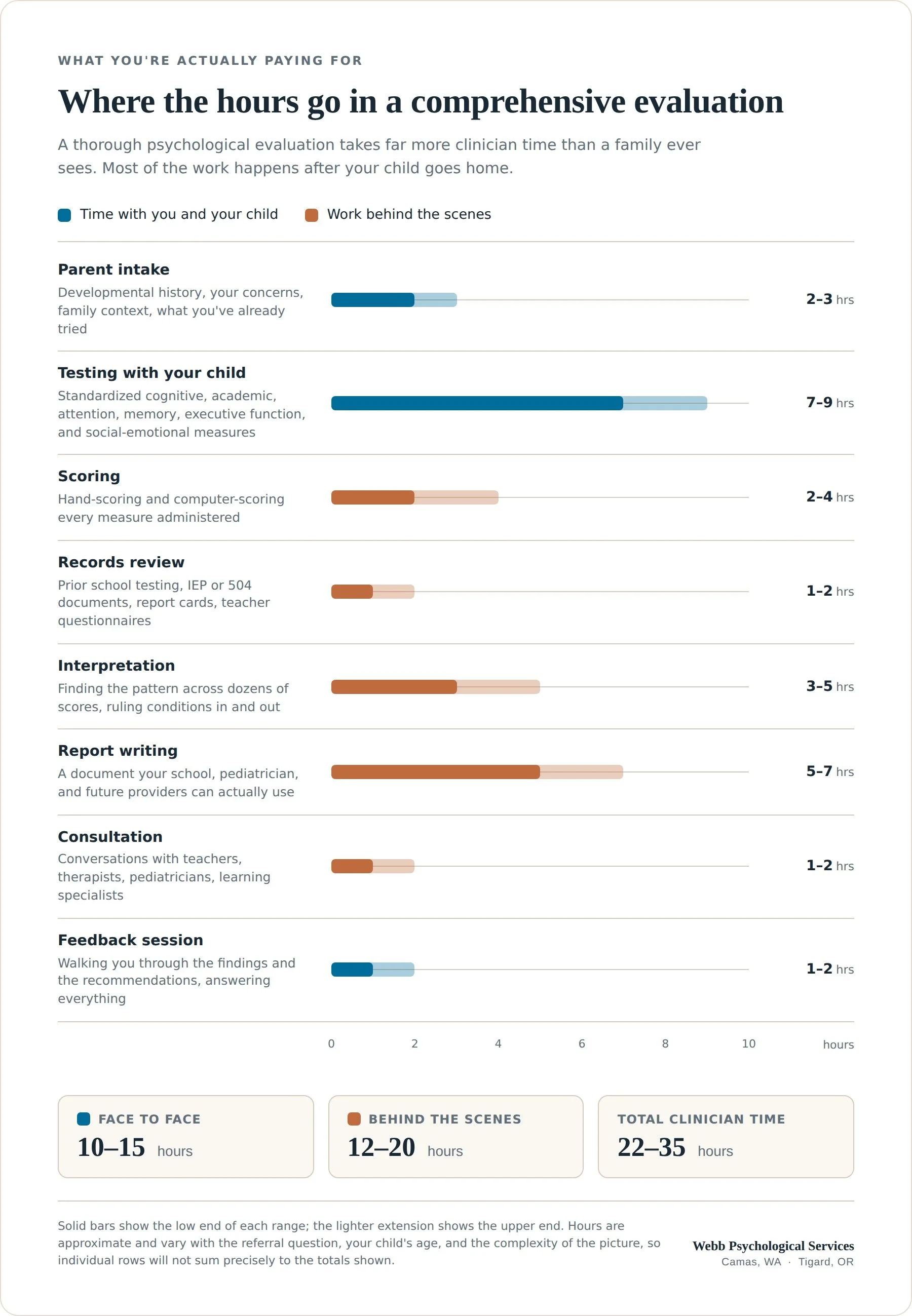
The length of a comprehensive assessment report often surprises parents, as it frequently runs thirty pages or more. However, this makes sense given how much it covers and the level of time, energy, and thought that goes into it, as shown above.
These kinds of reports are also designed this way to hold up if your school district reads it skeptically, if the College Board reviews it for accommodations, if a psychiatrist uses it to make a medication decision, or if your child reads it at nineteen and wants to understand themselves better. That is what you are really paying for.
If you want a fuller picture of what happens during the evaluation itself, we walk through the whole process in Psychological Testing for Children: What It Is and How It Can Help.
Will insurance cover psychological testing for my child?
Sometimes, partially, and it depends heavily on your specific plan and the reason for the referral. Evaluations pursued for medical or psychiatric questions (like ADHD, autism, anxiety, memory or attention), are more likely to be covered than evaluations pursued for educational questions only. Many plans specifically exclude testing for learning disorders on the grounds that it is educational rather than medical.
That distinction often times catches families off guard. Insurance companies generally cover what they consider medically necessary. A great many plans take the position that evaluating a child for dyslexia or a math learning disorder is the school's job, not the health plan's — even though schools frequently do not evaluate for those things at the depth a family needs.
The practical result is that two families with the same insurance card can have completely different experiences depending on what question their evaluation was designed to answer.
The second variable is whether the practice is in-network or out-of-network with your plan.
Webb Psychological Services, for example, is an out-of-network provider for all insurance carriers, meaning we do not bill insurance directly.
That is a deliberate choice. When a practice contracts with insurance carriers, the carrier gains a say in which tests can be administered, how many hours of testing are authorized, and how much time can be spent on interpretation and report writing. Most insurance companies require the entire evaluation (testing, report writing, and parent meetings) to take place in 8 hours or less. Those constraints push evaluations toward the shorter, more screening-oriented end goal, which is often exactly the kind of evaluation that sends a family back out the door with a label and no real understanding or practical supports. Staying out-of-network is how we protect the depth of the work.
What does "out-of-network" actually mean for my wallet?
It means you pay the practice up front, receive a superbill (an itemized statement of services with diagnostic and procedure codes), and submit that to your insurance company yourself for partial reimbursement. Among families we work with who have out-of-network benefits, many receive around 50% back, though this varies enormously by carrier, by plan, and by how the referral question is framed.
We provide the superbill at the conclusion of services, with the documentation your carrier will ask for. You submit it; the reimbursement comes back to you.
Some honest caveats, because we would rather set the expectation correctly than have you feel misled later:
If your plan has no out-of-network benefits, there is nothing to reimburse. Many HMO and some narrow-network plans have none at all. This is the first thing to find out.
You will likely have to meet an out-of-network deductible first. These are frequently separate from and higher than your in-network deductible. If your out-of-network deductible is $3,000 and you have not touched it, reimbursement starts after that.
Timing matters. If you are close to meeting your deductible in November, completing an evaluation in December looks very different financially than completing it in February.
Reimbursement is not guaranteed. We can give you accurate paperwork. We cannot promise you what your carrier will do with it.
How do I find out what my plan will actually pay?
Call the member services number on the back of your insurance card and ask these questions. Write down the answers, the date, the name of the representative, and the reference number for the call.
"Does my plan include out-of-network benefits for outpatient mental health services?" If the answer is no, everything below is moot, and you now know your real cost.
"What is my out-of-network deductible, and how much of it have I met this plan year?"
"Once the deductible is met, what percentage of the allowed amount do you reimburse for out-of-network outpatient mental health?"
"Do you cover psychological and neuropsychological testing — specifically CPT codes 96132, 96133, 96136, 96137, and 90791?" Ask about each one. Some plans cover the testing administration codes but not the interpretation codes, which changes the math substantially.
"Is prior authorization required for psychological testing?" If yes, ask what they need and obtain the required forms.
"Are there diagnoses you exclude from testing coverage?" This is where you will learn whether learning disorder evaluations are carved out of your plan.
"What is your deadline for submitting an out-of-network claim?" Often 90 days to a year from the date of service. Do not lose reimbursement to a filing deadline.
That call usually takes fifteen minutes and is the single highest-value thing you can do before committing to an evaluation anywhere, including here. We are happy to tell you which codes are likely to apply to your child's evaluation before you dial.
Isn't the school evaluation free?
Yes. If your child attends public school, the district is obligated to evaluate at no cost to you when there is reason to suspect a disability affecting their education. For some families, that evaluation is genuinely sufficient. But a school evaluation is built to answer a narrower question than most parents are actually asking.
School-based assessments — often called psychoeducational assessments — exist to determine one thing: whether a child qualifies for special education services or intervention under educational eligibility categories. That is a legitimate and important question, and school teams are frequently very good at answering it.
What school evaluations do not do:
Provide a diagnosis. Educational eligibility and clinical diagnosis are different things, and a child can qualify for one without meeting criteria for the other, or vice versa.
Examine emotional factors like anxiety, mood, and trauma responses, that may be driving what looks like a learning or attention problem.
Assess memory, processing speed, and executive function in depth.
Address the co-occurring picture, which is often the whole story. Anxiety and ADHD together look different than either alone. Giftedness layered over dyslexia can cancel out on a screening.
Our honest advice: start with the school evaluation. It costs you nothing but a written request, and for a meaningful number of families it answers the question well enough. If it comes back and you still feel like something is missing — if the findings do not match the child you live with, or the recommendations are thin, or the results simply say "does not qualify" while your child continues to struggle, that is the moment a private evaluation earns its cost.
If your child has already been evaluated by the district and you disagree with the results or suspect something more is going on, you may have the right to request an Independent Educational Evaluation (IEE) at public expense. We cover how that works in our guide to Independent Educational Evaluations.
And if your child has already had school testing, bring it. Prior evaluations meaningfully shape how we design a battery, and reviewing them is included in the fee.
Are there other ways to make this work financially?
Yes — there are several other paths to try if finances are a concern.
HSA and FSA funds. Psychological and neuropsychological evaluations are generally qualified medical expenses. If you have a health savings account or flexible spending account, those pre-tax dollars can usually be applied, which functions as a real discount. Confirm with your plan administrator.
Reduced-fee evaluation spots. Some clinics may hold a limited number of reduced-fee evaluation slots each year for families for whom cost is a genuine barrier. These are not advertised widely and they are limited, but they exist, and the only way to find out whether one is available is to ask.
Timing around your deductible. If you have out-of-network benefits and you are late in a plan year in which you have already met your deductible, moving quickly may save you meaningfully. If you are early in a fresh plan year, the reverse may be true.
Your right to a Good Faith Estimate. Under the federal No Surprises Act, if you are uninsured or choosing not to use insurance, you are entitled to a written Good Faith Estimate of expected charges before services begin. Any provider you talk to should give you one without hesitation. If a practice is cagey about producing one, treat that as information.
What should this money actually buy you?
If you are comparing practices (and you should) cost alone is a poor guide. A $1,400 evaluation and a $4,500 evaluation are frequently not the same service, and the difference usually shows up eighteen months later when you need the report to do something.
Questions worth asking as you’re considering practices, ours included:
How many hours of direct testing will my child receive, and is the number fixed or determined by the referral question?
Who administers the tests? In some settings a technician administers and a psychologist signs off. That is not automatically bad, but you should know.
Is the fee all-inclusive, or are scoring, report writing, and the feedback session billed separately?
How long until I have the written report in hand?
Will the report include specific, actionable recommendations, or a diagnosis and a list of generic strategies?
Will you consult with my child's school or pediatrician if I ask, and is that included?
Have your reports successfully supported accommodation requests with school districts and testing boards like the College Board?
That last question is especially important if working with a third party who is evaluating your child for academic or testing accommodations . If part of why you are testing is to support a 504 plan, an IEP, or SAT and ACT accommodations, the report has to be built to satisfy the entity reviewing it. We wrote about that specific standard in our post on evaluations for SAT and ACT accommodations.
Other Frequently Asked Questions
How much does psychological testing for a child cost? Comprehensive private evaluations generally run $3,000 to $6,000 nationally depending on scope and region. At Webb Psychological Services, evaluations are a flat $4,500, which includes intake, up to nine hours of testing, scoring, interpretation, records review, provider consultation, the written report, and a feedback session.
Does insurance cover psychological testing for children? It depends on your plan and the reason for testing. Evaluations for medical or psychiatric questions like ADHD, autism, or anxiety are more commonly covered than those for learning disorders, which many plans exclude as educational rather than medical. Call your carrier and ask specifically about out-of-network benefits and testing CPT codes.
Does Webb Psychological Services bill insurance? No. We are an out-of-network provider for all carriers and do not bill insurance directly. We provide a superbill at the conclusion of services for you to submit for reimbursement.
How much will insurance reimburse me? Among families with out-of-network benefits, most receive roughly 50% to 80% back after meeting their out-of-network deductible — but this varies substantially by carrier and plan, and families without out-of-network benefits receive nothing. Verify with your carrier before you begin.
Can I use HSA or FSA funds for psychological testing? Generally yes. Psychological and neuropsychological evaluations are typically qualified medical expenses. Confirm with your plan administrator.
Is the school evaluation free, and is it enough? Public school districts must evaluate at no cost when a disability is suspected. For some families that is sufficient. School evaluations determine special education eligibility but rarely provide a diagnosis or examine emotional factors, memory, and executive function in depth.
Do I need a referral from my pediatrician? No. A formal referral is not required, though we are glad to review pediatrician records if you have them.
Do you offer reduced fees? We reserve a limited number of reduced-fee evaluation spots each year for families for whom cost is a barrier. Reach out and ask — we are happy to discuss whether one may be available.
A note on how we structure our fees at Webb Psychological Services.
We limit the number of families we take on each month. That is not a scarcity tactic — it is what makes it possible for Dr. Webb to spend twenty-plus hours behind the scenes on a single child, return calls within a day, and talk to a teacher on a Tuesday afternoon because it will make the recommendations better.
Some specifics, so nothing is a surprise:
Evaluations are $4,500, flat.
Therapy is $250 per hour.
Records review, provider consultation, and the feedback session are included, not billed separately.
No pediatrician referral is required to schedule an evaluation, though we welcome records if you have them.
We do not provide court-mandated, custody, parenting capacity, or any forensic (legal) evaluations.
Consultations are free. Before you commit to anything, you can talk to us about whether an evaluation is even the right next step. Sometimes the honest answer is that it isn't — that therapy first, or a conversation with the school, makes more sense right now. We would rather tell you that than take your money. We wrote about how to think through that decision in Assessment or Therapy First?
If cost is the thing standing in your way, please tell us that.
We work with families across Tigard, Lake Oswego, West Linn, Camas, Portland, Vancouver, and the surrounding metro, and the conversation about money is one we have often and without any awkwardness. Sometimes there is a reduced-fee spot. Sometimes the answer is that your insurance will cover more than you assumed. Sometimes it is that the school evaluation really is the right first move and you should save your money for now.
What we do not want is for you to spend another year wondering, because a number you never asked about felt too big to say out loud.
Schedule a free consultation at no cost or obligation. We will give you a straight answer about whether an evaluation makes sense for your child and what it would actually involve.
Webb Psychological Services provides comprehensive psychological and neurodevelopmental evaluations and therapy for children, adolescents, and young adults, with offices in Camas, WA and Tigard, OR.