
Many parents come to the question of autism slowly. There's often a long stretch of sensing that something is a little different, without quite being able to name it. You might hear yourself saying things like "They have friends, they just never seem to last," or "They're fine at school and fall apart the minute they get home," or "They're the most empathetic kid I know, so it can't be autism." Maybe you've already asked a professional and been told your child seems fine. If any of that sounds familiar, you're far from alone.
Part of what makes this so hard to see is that most of us carry a fairly specific picture of autism, and many autistic kids don't match it. On their own, things like short-lived friendships or after-school meltdowns don't mean much, which is why they're so easy to explain away. What tends to matter is whether several show up together. It's a big part of why girls are among those most often missed. A 2026 analysis in JAMA Network Open found that girls and women were diagnosed an average of 3.4 years later than boys and men. It happens to many other kids too, including boys who are quiet or eager to please, bright kids with big vocabularies, gender-diverse kids, and children of color, who research shows are often identified later than white children.
Every child's profile is different, and our understanding of autism is still growing, but a few things are worth knowing from the start:
Less obvious autism is easy to miss, especially in girls and in children whose cultural background shapes how their behavior is read. It can look like intense interests in ordinary topics, friendships they want but struggle to keep, eye contact that was learned rather than natural, and holding it together at school before falling apart at home.
It's a spectrum, and every profile is uneven. A child can be strong in some areas and struggling in others, including how they handle sensory input, and look very different from one setting to the next.
It rarely comes alone. ADHD, anxiety, depression, OCD, learning differences, sensory processing difficulties, giftedness (a twice-exceptional, or 2e, profile), and burnout often show up alongside autism, and any of them can be what gets noticed first.
A brief screening can miss all of this. A comprehensive evaluation looks at developmental history, your child's own account, more than one setting, and how the pieces fit together.
None of this is a checklist. If some of it sounds like your child and some doesn't, that's normal, and still worth a conversation.
The rest of this post walks through each of these in more detail, starting with why less obvious autism is so easy to miss.
Why it's so easy to miss, even when you're paying close attention.
Part of it is that the picture itself was built on boys, mostly boys whose differences were easy to see. The earliest descriptions of autism came from those samples, and the criteria, the screening tools, and the mental image most of us carry all descend from them. A child whose autism doesn't resemble that template often isn't read as autistic. They're read as shy, anxious, sensitive, dramatic, defiant, or gifted-but-struggling.
The larger part is masking, the work of suppressing autistic traits and presenting as though everything is fine. Girls tend to mask earlier and more effectively, though plenty of boys and gender-diverse kids do it too. And masking gets better with practice.
A seven-year-old's version is clumsy and fairly easy to spot. By thirteen or fourteen, a girl who has been studying other people for years can produce something that looks natural: rehearsed conversational openings, expressions borrowed from her peers, eye contact she has taught herself to hold. Research on adolescent autistic girls finds them camouflaging even in settings adults assumed were safe, because the risk of getting it wrong never goes away.
She may also be outworking the problem. Bright kids often compensate by putting in two or three times the effort everyone else does, and the resulting report card closes the conversation before it starts. Nobody refers a kid with good grades.
What she can't do is hide the cost. When parents tell us they feel they should have noticed sooner, we gently push back, because most of the time you were seeing it. Masking tends to come off at home. Girls in that same research describe home as the one place they can stop performing, and their mothers describe what that looks like: a child who comes home drained and on edge, who is tearful over nothing much, who has stomachaches, who melts down after school over something small.
Those are the cues that she's running overtime. The difficulty is that every one of them also looks like ordinary adolescence, or a sensitive kid, or a hard week. The information was there. It just didn't announce what it meant.
And working overtime isn't sustainable. Camouflaging draws down energy that has to be repaid, and when it isn't, the debt accumulates. A recent systematic review of autistic people's own accounts describes burnout as this kind of cumulative effect rather than a reaction to any single event. One participant compared long-term camouflaging to plaque building up in an artery over time.
In a teenager, that usually doesn't look like a bad day. It looks like a collapse that seems to come out of nowhere: sudden school refusal, a drop in functioning, a withdrawal that doesn't lift, or a meltdown on a scale that frightens a family who thought things were okay. People describe reaching a point where they're too drained to keep the mask up. From the outside, it reads as a sudden change. From the inside, it's the end of something that had been going on for years.
This is one reason adolescence and early adulthood are the pressure points. Academic and social demands escalate fastest then, the strategies that used to work stop being enough, and those are the stages our diagnostic tools were least designed around.
None of this is only a parent problem, either. Research has found that cognitively able girls are diagnosed significantly later than boys despite comparable parental concern and a comparable number of professional referrals. Families were raising it, and the system was slower to act. When girls and boys are rated similarly on autism measures, girls, particularly those with higher IQs, are less likely to end up with a diagnosis. If you've brought this up more than once and come away feeling gently dismissed, you're not imagining that pattern.
There is reason for optimism. In that same JAMA analysis of more than 171,000 patients, diagnoses among boys and men held steady or declined between 2016 and 2024, while diagnoses among girls and women rose sharply after 2020, which the researchers read as recognition catching up rather than more autistic people suddenly existing. CDC surveillance points the same way. It identifies autism in about 1 in 31 eight-year-olds, with about 3.4 boys identified for every girl at that age, but among four-year-olds the ratio is 2.8 to 1. Younger children, screened more recently and with better awareness, show a smaller gap. We'd add one honest caveat: this is an area where the research is moving, and some of what the field believed ten years ago has already shifted.
None of it means every tired, socially uncertain child is autistic. Most aren't. It does mean that "they seem fine" is worth holding a little more loosely than it usually is.
Autism is a spectrum, and every profile is going to look a little different.
"Spectrum" is often heard as a line running from mild to severe. It's closer to a mix of traits, each of which can be stronger or quieter in a given child. A child might have an advanced vocabulary and real difficulty with back-and-forth conversation. They might be calm and focused during a structured task and completely overwhelmed in a loud cafeteria. They might manage well one year and struggle the next, as the demands around them change.
That unevenness is a big part of why less obvious autism gets missed. People see the strengths and assume the struggles must be about effort or attitude. It's also why many clinicians have moved away from labels like "high-functioning," which tend to describe how a child looks to others rather than how hard things are for them.
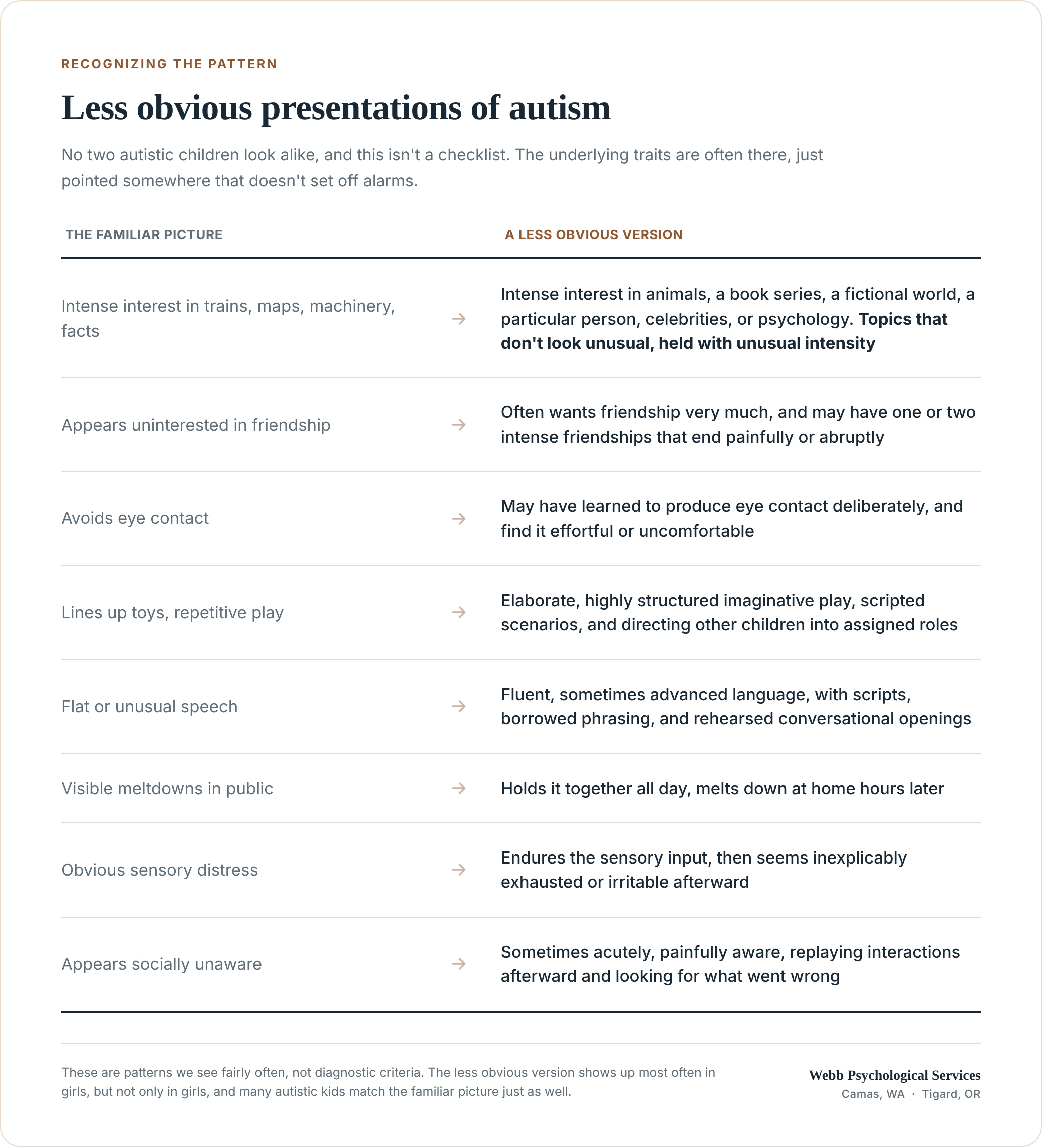
The thread through the right-hand column is that the underlying trait is present, but it's pointed somewhere that doesn't set off alarms.
An eleven-year-old who can tell you everything about horses isn't remarkable. An eleven-year-old who can tell you everything about horses, has reorganized her room around them, finds it hard to talk about anything else, and becomes distressed when the conversation moves on may be showing the same intensity that gets a boy referred when his subject is train timetables. The interest passed as ordinary. The intensity is what's worth noticing.
What masking involves:
Masking, or camouflaging, is the work of suppressing autistic traits and presenting as non-autistic. It can include rehearsing conversations in advance, mimicking peers' expressions and mannerisms, deliberately producing eye contact, suppressing stims, and building a social persona by studying other people, sometimes quite explicitly, from television, books, or one closely observed classmate.
Not every autistic person masks, and it isn't unique to girls. It's exhausting, largely invisible, and effective, which is exactly what makes it hard to catch.
We covered the exhaustion and burnout above. Three quieter costs are worth naming, because families don't always connect them to anything:
Identity confusion. Autistic adults who masked for years tend to describe it in strikingly similar ways: losing track of who they are underneath the performance, and not being sure which reactions are their own. In a teenager, this can look like an unsettled sense of self that gets chalked up to ordinary adolescence.
Anxiety and low mood. Masking is strongly associated with both. It also tends to produce a particular internal logic: I can only be accepted as a version of myself I have to construct.
A story they tell about themselves. The longer a child goes without an explanation, the easier it becomes to conclude that the problem is who they are, that other people manage because they're better at being people. That belief is much harder to undo at twenty-five than at fourteen.
The same pattern shows up in girls with ADHD, which we've written about in How ADHD Presents Differently in Girls vs. Boys.
It's rarely just autism.
Autism often comes with company. A large 2019 review in The Lancet Psychiatry estimated that among autistic people, about 28% also have ADHD, 20% an anxiety disorder, 13% sleep difficulties, 12% a behavior-related diagnosis such as oppositional defiant disorder, 11% depression, and 9% OCD. Many children have more than one.
Other things travel alongside autism as well:
Learning differences, like dyslexia or dysgraphia, and language or motor coordination difficulties.
Sensory processing difficulties. Sensory differences are part of autism itself, and many kids are identified with sensory processing difficulties first, often by an occupational therapist, before anyone considers autism.
Tics, which are more common in autistic kids than in their peers.
Giftedness. Some autistic kids are also gifted, a twice-exceptional, or 2e, profile where strengths and struggles can hide each other.
Burnout. Autistic burnout, the exhaustion that builds after years of masking, can look a lot like depression.
These don't just sit next to autism. They change how it looks, and they're often what gets noticed first:
Anxiety is diagnosed and treated, and it eases a little but never quite resolves, because some of it is coming from autistic stress no one has recognized yet.
ADHD is diagnosed and treated, and focus improves, but the social exhaustion and need for sameness are still there.
Rigid routines and repeated checking get called OCD, when some of it is an autistic need for predictability, or both are true at once.
A child is labeled oppositional, when the meltdowns and refusals are coming from overwhelm or a sudden change in plans.
Sensory difficulties are addressed in occupational therapy, which helps, but no one connects them to the social and emotional pieces of the picture.
The ADHD and autism combination is common enough to have its own informal name, AuDHD, and it can look contradictory: craving routine while acting impulsively, deep focus on some things and almost none for others, social exhaustion alongside social impulsiveness.
None of these is wrong on its own. Each is often just incomplete. That overlap is a large part of why we evaluate comprehensively rather than answering one question at a time. We've written more about the overlap in ADHD or Anxiety? How to Tell the Difference in Your Child and about anxiety that can mask something deeper.
But they're empathetic and have friends. Doesn't that rule it out?
Not on its own, and it's one of the most common reasons a family gets reassured and sent home.
Autistic children are not unfeeling. Many are intensely empathetic, sometimes to the point of being overwhelmed by other people's emotions. What can be harder is the fast, automatic reading of social signals, which is a different thing from caring about the person sending them.
Wanting friends isn't evidence against autism. Many autistic kids, and girls especially, have strong social motivation alongside real difficulty sustaining friendships, particularly around conflict, which is much of what friendship involves by middle school.
Eye contact can be learned. Producing it because you've worked out that people expect it isn't the same as finding it natural.
Verbal fluency isn't social fluency. A child with a rich vocabulary and a gift for scripted conversation can be very hard to read in a fifteen-minute appointment.
If a provider set autism aside after a brief conversation, it's quite possible they saw the version your child is practiced at producing. That's not a criticism of them. Masking is, in a sense, designed to produce exactly that impression, and short appointments are short.
What does a thorough autism evaluation look at?
Standardized autism observation tools are valuable, and we use them. But they were normed largely on male presentations, and they assess behavior in a structured setting over a limited window, which happens to be the situation a well-practiced masker handles best. A child who has spent years learning to perform can produce a presentation that doesn't flag on structured observation while being autistic in everyday life.
That's why we try not to rest a conclusion on any single tool or score. A comprehensive evaluation with a trained, doctoral level psychologist gathers several kinds of information and looks at how they fit together:
Developmental history, in detail. Milestones, and also the texture: what their play looked like at four, how birthday parties went, whether transitions were hard, what happened when the routine broke.
Your child's own account, when they're old enough to offer one. Older kids often describe their inner experience with real clarity once someone asks the right question: what it costs to talk to people, what they're calculating mid-conversation, whether they've ever felt like they're performing.
Information from more than one setting. Caregiver and teacher questionnaires are a standard part of our evaluations, and the differences between settings are often as informative as the ratings themselves.
Cognitive and language profile, including the uneven patterns that often accompany autism.
Sensory and regulation patterns, including the endure-now-collapse-later profile that can look like nothing at all at school.
Careful differential work across ADHD, anxiety, OCD, mood, learning and language differences, sensory processing, and giftedness, and the several-at-once combinations that are closer to the rule than the exception.
Clinical judgment, informed by what masking and less obvious presentations tend to look like.
One thing worth saying plainly, since it comes up in nearly every intake: what you see at home counts. When a school reports no concerns, they're usually being honest. They're describing the managed version, because that's the version they get. You're not an unreliable narrator because you're the parent. Quite often you're the only person with access to the rest of it.
You can read more about how we approach evaluations in Beyond the Labels, about how culture shapes assessment in our post on culturally responsive evaluations, and about our process on our Autism Testing page.
Sometimes the answer is no, and that's useful too.
A fair number of the children we evaluate for autism are not autistic.
Sometimes what looks like autism is anxiety, a learning difference, ADHD, a sensory profile that doesn't meet criteria, a bright child in a poorly fitting environment, or a kid going through something hard. Sometimes it's more than one of those. And sometimes we find a picture nobody expected, including us.
That isn't a wasted evaluation. Knowing what isn't going on narrows the field, stops a family from pursuing supports that were never going to help, and usually replaces a vague worry with something specific enough to act on. Parents sometimes hesitate to ask, worried they'll be seen as looking for a label. In our experience, most are looking for an explanation that fits their child, and they're open to whatever that turns out to be.
Other Frequently Asked Questions
Why is autism diagnosed later in girls than boys? Diagnostic criteria and screening tools were developed largely from male samples, and girls more often mask autistic traits by mimicking peers, rehearsing social interactions, and suppressing stims. Research also suggests girls may need to show greater overall difficulty before being diagnosed, particularly girls with higher IQs.
What are signs of autism in girls that get overlooked? Intense interests in socially typical topics like animals or fictional characters, one or two very intense friendships that end painfully, eye contact that was learned rather than natural, scripted conversation, holding it together at school and melting down at home, sensory sensitivities endured rather than displayed, and exhaustion out of proportion to the day. None of these is diagnostic on its own.
Can boys have a less obvious presentation of autism too? Yes. Boys who are quiet, compliant, highly verbal, or gifted can mask too, and their autism may be read as shyness, anxiety, or ADHD instead. Less obvious autism is most often described in girls, but it isn't limited to them.
What if my pediatrician says my child seems fine? Pediatricians are working with a short appointment and a screening tool, and most screening tools are less sensitive to the presentations described here. "Seems fine to me" is usually an honest account of what they saw, not a conclusion about autism. It helps to bring specifics rather than impressions ("she rehearses what she'll say before ordering a pizza, and she's had four friendships end the same way"), to describe what you see at home, and to ask directly for a referral for a comprehensive evaluation. You can also self-refer. A pediatrician's referral isn't required to schedule an evaluation with us.
Does a negative autism screening rule out autism? Not necessarily, especially for kids who mask well. Brief screeners and structured observation tools can under-detect less obvious presentations. A comprehensive evaluation draws on developmental history, information from multiple settings, the child's own account, and clinical judgment rather than a single instrument.
My child is already a teenager. Is it too late to evaluate? No. Adolescence and early adulthood is when many kids with less obvious presentations are finally identified, often because masking has stopped being sustainable. An evaluation at this stage can open the door to school accommodations and the right kind of support, and it can give your teen an accurate way to understand themselves before they build an adult identity around the idea that they're bad at being a person. The most common reaction we see in a feedback session with a teenager is relief.
If you've been wondering about your child for a while, we’d love to hear from you.

Most parents who reach out to us have been wondering for a long time. Many have been reassured at least once by someone who meant well, or told they're reading too much into it.
You don't need to be certain before you call. A consultation with Dr. Webb is free and takes about fifteen minutes. You can share what you're seeing, ask whatever's on your mind, and get an honest sense of whether an evaluation makes sense right now. If it doesn't, or if something else would help more, we'll tell you that too.
Reach out today to see if an evaluation is the right next step for your child. We see children, teens, and young adults at our offices in Camas, WA and Tigard, OR, both set up to feel calm and welcoming for kids, and we work with families across the Portland and Vancouver area.
If you want to dive deeper into this topic:
One name worth knowing is Dr. Donna Henderson, PsyD, a clinical neuropsychologist with more than 30 years of experience. She evaluates children, teens, and adults at The Stixrud Group in Silver Spring, Maryland, and much of her work focuses on the less obvious ways autism can show up, especially in girls and women who have learned to mask. She also spends a good part of her time teaching other clinicians to recognize those presentations.
With Dr. Sarah Wayland and Dr. Jamell White, she co-wrote Is This Autism? A Guide for Clinicians and Everyone Elseand a follow-up, Is This Autism? A Companion Guide for Diagnosing. The first is the better starting place for parents. It’s written with professionals in mind, but it’s very readable if you want the fuller picture.
She also talked through much of this on an episode of The Testing Psychologist podcast on autism in girls and women. It's a conversation aimed at clinicians rather than parents, but it includes a candid stretch on how a clinician's own assumptions shape who gets assessed, which is worth hearing from the inside.
